When Should My Pregnant Dog See a Veterinarian.
When Should a Pregnant Dog Have an X-Ray? What Fetal Bone Development Can Tell Us

Pregnancy in dogs often brings excitement, anticipation, and plenty of questions. One of the most common questions breeders and dog owners ask is when a pregnant dog should have an X-ray. The timing matters because radiographs are not equally useful throughout the entire pregnancy. Early on, fetal skeletons are not yet mineralized enough to be seen clearly. Later in pregnancy, however, X-rays can provide very helpful information that supports planning, monitoring, and maternal care.
At Bushnell Animal Clinic, Dr. Roger Hart uses diagnostic imaging as part of a thoughtful approach to evaluating pregnancy and helping owners better understand what is happening as whelping approaches. Radiographs are not just about curiosity. When done at the right time, they can help us confirm pregnancy progression, evaluate fetal skeleton development, and use that information strategically for the health and care of the mother.
Understanding when fetal bones begin to ossify and when puppies become visible on X-ray helps explain why timing is so important.
Why timing matters in canine pregnancy radiographs
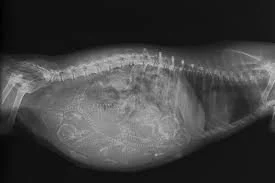
A dog can be pregnant long before radiographs become especially helpful. In the earlier stages of pregnancy, fetal structures are developing, but the bones have not yet mineralized enough to stand out clearly on X-ray. That means a radiograph performed too early may not tell us very much.
This is one of the most important points for dog owners to understand. X-rays are not the best tool for very early pregnancy detection. They become more useful later, when fetal skeletons begin to mineralize and can be seen more clearly.
At that point, radiographs can help us:
confirm later-stage pregnancy progression
better evaluate fetal skeleton visibility
support planning as whelping approaches
help assess what is happening in relation to the mother’s body and comfort
provide practical information that can guide care decisions
That is why the value of pregnancy radiographs depends heavily on timing.
When fetal bones begin to ossify
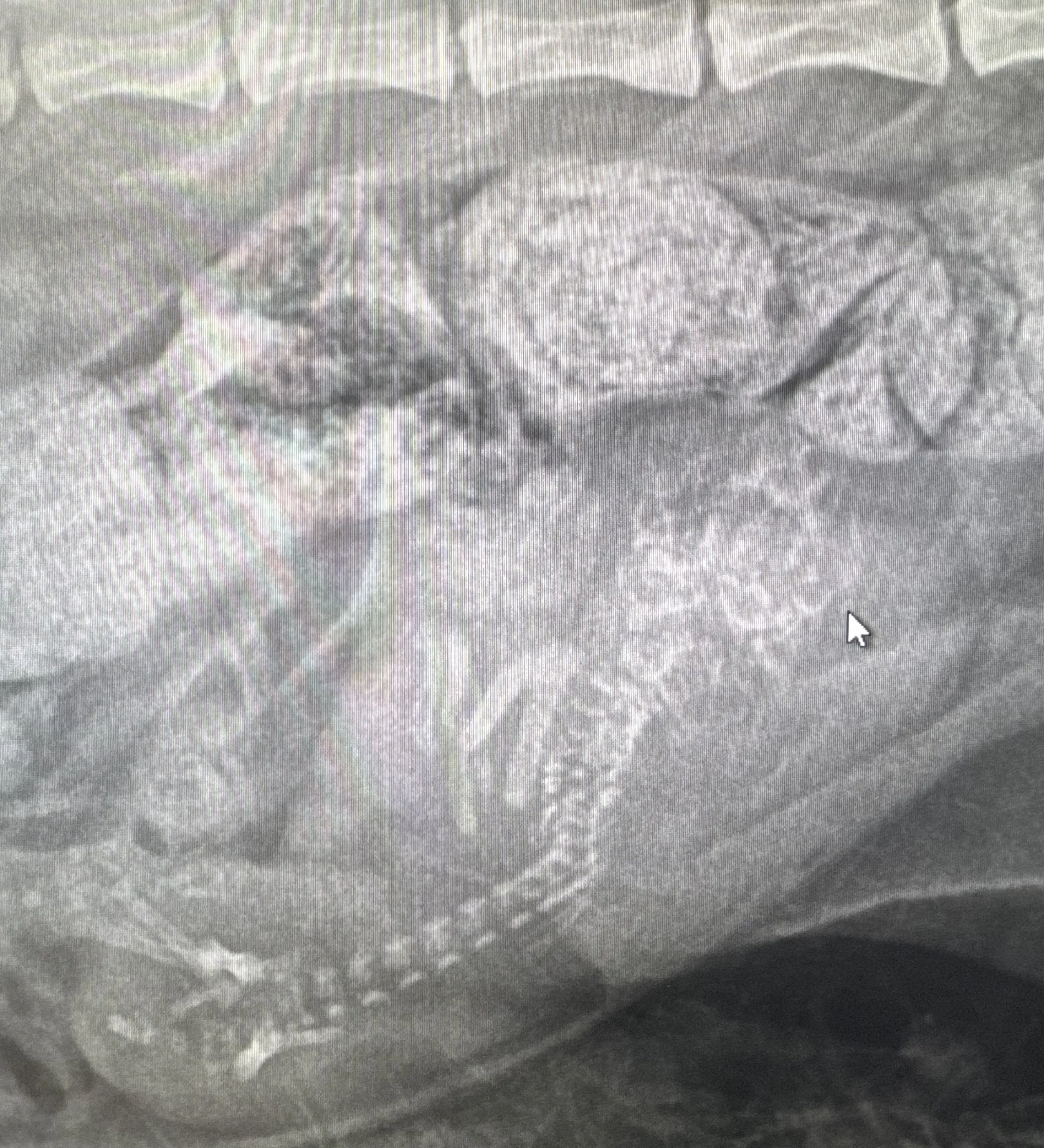
In developing canine fetuses, bones begin to ossify later in gestation. Ossification refers to the process by which the developing skeleton begins to mineralize and become visible on X-ray. Before that stage, the fetal skeleton is not easily seen on radiographs.
As pregnancy progresses and fetal bones ossify, radiographs become much more informative. Once skeletal structures are visible, we can begin to use X-ray findings in a more strategic and practical way.
This matters because it helps answer one of the most common owner questions:
Why not just take an X-ray earlier?
The answer is simple. If the fetal skeletons are not yet visible enough, the radiograph is less useful. Waiting until bones are more clearly mineralized gives us better information and makes the imaging more meaningful.
The opportune time to take an X-ray

The most useful time to take a pregnancy radiograph is later in gestation, when fetal bones are ossified enough to show clearly on the study. At that stage, the radiograph can offer a much better look at fetal skeleton development and provide information that helps with planning and monitoring.
The goal is not simply to take an X-ray as soon as pregnancy is suspected. The goal is to choose a point in pregnancy when the information gained will actually be useful.
When radiographs are timed appropriately, they can help:
confirm that fetal skeletons are visible
provide a clearer picture of later-stage pregnancy
help owners better prepare for whelping
support monitoring of the mother as delivery approaches
That is why timing is part of good medical decision-making. It is not just about whether an X-ray can be done. It is about when it is most worthwhile to do it.
Why not rely only on appearance or behavior?
Owners sometimes assume they can judge the stage of pregnancy based only on abdominal enlargement, nesting behavior, appetite change, or movement. While those observations can be helpful, they are not always precise. A dog may look visibly pregnant, but that does not automatically mean a radiograph will provide the most useful information yet. On the other hand, some later-stage pregnancies benefit from imaging even when the dog still seems comfortable and normal overall.
This is one reason veterinary timing matters. A dog’s physical appearance does not always tell the whole story about what stage the fetuses have reached internally. Imaging can help us better understand what is happening rather than relying only on visible changes from the outside.
How X-rays help us use information strategically
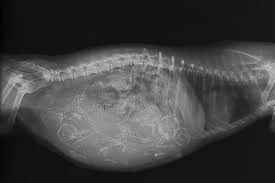
Pregnancy radiographs become especially useful when we are thinking ahead. Once fetal skeletons are visible, the information is not just interesting. It can help support practical planning for the mother’s care.
Strategically, radiographs may help with:
understanding where pregnancy stands as whelping gets closer
preparing owners for expected delivery timing
supporting decision-making if concerns arise late in pregnancy
giving context for what is happening if labor does not seem to progress normally
helping us better assess late-pregnancy abdominal findings
The real value is not only in “seeing the puppies.” It is in using imaging information in a way that better supports preparedness, maternal monitoring, and next-step decisions when needed.
Supporting the mother’s health
A pregnancy radiograph is not only about the fetuses. It is also about the mother. As whelping approaches, owners naturally want to know that they are doing everything they can to prepare and recognize when something may not be progressing normally.
Used at the right stage, radiographs can support that preparation by giving us a clearer picture of what is happening internally. This may help reduce uncertainty and give owners more confidence about the road ahead.
Maternal health matters throughout pregnancy, but it becomes especially important as delivery gets closer. A dog that is late in pregnancy, uncomfortable, not acting as expected, or raising questions about timing may benefit from thoughtful evaluation. In some cases, urgent / emergency caremay also be relevant if whelping concerns become more serious.
Why radiographs are not just about counting puppies
One of the most common reasons owners ask about pregnancy X-rays is to know how many puppies to expect. While radiographs can often help with later-stage assessment, their value goes beyond counting alone.
Radiographs also help by:
showing fetal skeleton development
confirming that ossification has progressed enough for useful imaging
assisting with planning and preparedness
offering additional information if pregnancy progression or labor later becomes a concern
When owners focus only on the number of puppies, they may miss the broader medical usefulness of the study. The timing of the X-ray and the context in which it is used often matter just as much as the count itself.
Preparing for whelping
Late pregnancy can be stressful for owners, especially if it is their first experience with a pregnant dog. Questions often come up such as:
When should I expect whelping?
Is everything progressing normally?
When should I worry?
How can I be as prepared as possible?
This is where thoughtful veterinary guidance matters. Radiographs can become part of a bigger preparation plan that includes close observation, communication, and understanding what signs may deserve attention.
Owners should remember that an X-ray is not a substitute for monitoring the mother carefully. Instead, it works best as one piece of the overall picture.
When to call your veterinarian
Owners should contact their veterinarian if a pregnant dog is:
showing unusual discomfort
not eating normally
acting weak or lethargic
having abnormal discharge
showing signs of distress
appearing overdue or not progressing as expected near delivery
experiencing possible whelping complications
Even when the question begins as “Should we take an X-ray yet?” the bigger issue may be whether the mother needs evaluation for some other reason. That is why context matters so much.
If a dog near delivery is not acting normally, the situation may call for more than routine discussion. In those cases, prompt communication is important.
How diagnostic imaging fits into pregnancy care
At Bushnell Animal Clinic, Dr. Roger Hart uses diagnostic imagingas part of a broader medical approach. Radiographs are most helpful when used thoughtfully, at the right stage, and with a clear purpose in mind.
For pregnancy, that purpose may include:
later-stage fetal evaluation
strategic preparation for whelping
better understanding of fetal skeletal development
helping owners know what to expect
supporting informed decision-making when concerns arise
This is a good example of how imaging can be most useful when it is timed well and interpreted as part of the larger clinical picture.
Why owners should not wait too long if concerns arise
Although timing matters for useful radiographs, owners should not confuse that with delaying care when something seems wrong. A dog that appears distressed, ill, painful, or abnormal should not simply be watched because someone is waiting for the “perfect time” to image the pregnancy.
If concerns arise, the correct next step may be an exam, urgent assessment, or medical evaluation rather than simply waiting. Strategic timing is important, but so is recognizing when the mother’s condition deserves prompt attention.
The value of a doctor-led approach
Pregnancy questions are often best answered in context, not by guessing from dates alone. The mother’s breed, body size, pregnancy stage, physical findings, and overall condition all affect how we think about imaging and timing.
That is why a doctor-led approach matters. A radiograph is not helpful just because it exists. It becomes helpful when used at the right time, for the right reason, and as part of a thoughtful plan for the dog’s care.
Final thoughts
The best time to take an X-ray on a pregnant dog is later in gestation, when fetal bones have begun to ossify enough to show clearly on radiographs. Before that stage, the study may not provide the same value because fetal skeletons are not yet visible enough to guide decision-making in a meaningful way.
When timed appropriately, pregnancy radiographs can help us better evaluate fetal development, support preparation for whelping, and use imaging more strategically for the health and care of the mother. Their value is not only in seeing the puppies, but in understanding what that information means and how it fits into the bigger picture of pregnancy care.
At Bushnell Animal Clinic, Dr. Roger Hart provides thoughtful diagnostic imagingand pregnancy-related evaluation for dogs in Bushnell, Florida. If you have questions about timing, fetal development, or concerns as whelping approaches, veterinary guidance can help you make better decisions for both the mother and her puppies.
